WASHINGTON (AP) — Scientists created virtual replicas of patients’ diseased hearts so precise that blocking a dangerous irregular heartbeat in these digital “twins” showed doctors how to better treat the real thing.
One of the first clinical trials of these custom models suggests it might improve care for ventricular tachycardia, a notoriously difficult-to-treat arrhythmia that is a major cause of sudden cardiac arrest, blamed for about 300,000 U.S. deaths a year.
The study, by researchers at Johns Hopkins University, was a small first step. The Food and Drug Administration allowed the digital twin technology to guide treatment for just 10 patients, and much larger studies will be needed.
But the results reported Wednesday in the New England Journal of Medicine come as doctors increasingly are exploring how a technology long used in aerospace and other industries might be harnessed for better health, too.
Dr. Jeffrey Goldberger, a heart specialist at the University of Miami who wasn’t involved with the study, experimented with more rudimentary iterations 15 years ago and praised the new findings. “This is what we envisioned,” he said.
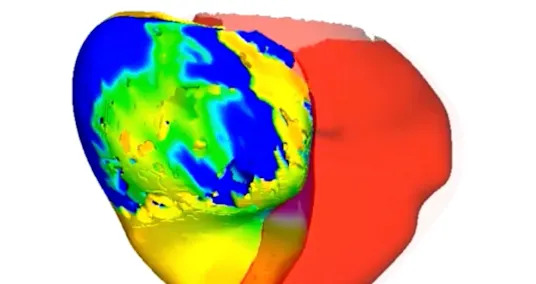
Doctors have long used 3D models, both physical and computer-generated ones, to simulate disease and practice techniques. But Hopkins biomedical engineer Natalia Trayanova said true digital twins predict how a real organ can react to different treatments. Her lab is pioneering colorful interactive models developed with an advanced MRI scan and other data from each patient.
“We treat the twin before we treat the patient,” Trayanova said. “Did it work? And if it did, are there new things that arise” that will require more or different care?
The heart’s electrical system powers our heartbeat. Ventricular tachycardia is a super-fast heartbeat triggered when an electrical wave short-circuits in the organ’s bottom chambers, the ventricles, and prevents them from pumping blood out to the body.
“You see this heart that is basically quivering,” Trayanova said.
Medication can help but the main treatment is ablation, when doctors thread catheters to the heart to burn misfiring tissue. But it's a bit trial-and-error, as patients spend hours under anesthesia while doctors determine where to aim. Repeat ablations are common, and many patients have an implanted defibrillator as backup.
Enter Trayanova’s digital twins of patients’ ventricles. Colors swirl on a computer screen – blue, green, yellow and orange – showing how the heart’s electrical wave moves across the chamber’s healthy areas before getting stuck on damaged tissue. It’s trapped in a circular motion that she compares to the swirl of a hurricane.
“It allows me to recreate the functioning of the patient’s organ and then predict what is the best way to ablate,” she said.
The technology locates a dysfunctional region where the electrical wave repeatedly hits. Virtually ablating it will show if that solves the problem or if another arrhythmia forms that also will need zapping. “Then we poke it again,” she explained.
Trayanova’s team created customized ablation targets for each of the 10 study participants. Cardiologists transferred them to a mapping system they use as a guide and aimed just at those targets instead of hunting their own.
More than a year later, eight patients had no arrhythmias while two experienced only a single brief episode while they were healing -- better than the treatment’s typical 60% success rate, said Dr. Jonathan Chrispin, a Hopkins cardiologist and the study’s lead author. All but two also stopped their anti-arrhythmia medicine.
More importantly, cardiologists may burn away less tissue by targeting "specifically the areas that we think are critically important,” Chrispin said. “We could potentially make these procedures shorter, safer, more effective.”
The Hopkins team hopes to study the digital twin approach in a larger study with other hospitals, and has begun a trial using it to treat a more common type of irregular heartbeat called atrial fibrillation. Other researchers are studying digital twins for cancer care.
___
The Associated Press Health and Science Department receives support from the Howard Hughes Medical Institute’s Department of Science Education and the Robert Wood Johnson Foundation. The AP is solely responsible for all content.
NEUESTE BEITRÄGE
- 1
 RFK Jr. succeeds in changing hepatitis B recommendation | The Excerpt09.12.2025
- 2Figure out How to Amplify the Resale Worth of Your Kona SUV17.10.2023
- 3Empathy and reasoning aren’t rivals – new research shows they work together to drive people to help more02.12.2025
- 4'Harry Potter' fans rejoice: HBO releases 1st trailer for new TV series, set to premiere this Christmas25.03.2026
- 5Artemis II astronauts channel Apollo 8 with a striking Earthset photo07.04.2026
- 6World leaders, rights groups react to COP30 climate deal22.11.2025
- 74 astronauts depart ISS, leaving behind just 3 crewmates to staff the orbiting lab14.01.2026
- 8Nikki Glaser returns as host of the 2026 Golden Globes: Everything the comedian has said about the upcoming awards show07.01.2026
- 96 Travel Services for Colorful Get-aways: Pick Your Fantasy Escape06.06.2024
- 10People can't get enough of this couple's Hallmark movie reviews. They don't know the painful backstory.17.12.2025
- 11Your big brain makes you human – count your neurons when you count your blessings26.11.2025
- 12Vote in favor of your Number one method for commending a birthday05.06.2024
- 13German Winemakers Rewrite The Rules Of Riesling In A Warming World07.04.2026
- 14Book excerpt: "Enough" by Dr. Ania Jastreboff and Oprah Winfrey11.01.2026
- 15IDF kills senior PIJ Gaza City Brigade cmdr. who infiltrated Kibbutz Nahal Oz on Oct. 701.12.2025









Ähnliche Artikel
- Artemis 2 captures historic 'Earthset' photo | Space photo of the day for April 7, 202607.04.2026
- Tesla Germany Registrations Quadruple to 9,252 Vehicles in Best March Ever07.04.2026
- What's going on with Katseye? The Manon Bannerman hiatus drama, explained.07.04.2026
- Two IDF officers, civilian face indictment in alleged Gaza aid-truck smuggling scheme07.04.2026
- West Palm Beach Shorecrest, renderings of downtown waterfront condo07.04.2026
- Artemis II astronauts make long-distance call to the space station as they head home from the moon07.04.2026
- Tuesday, April 7. Russia’s War On Ukraine: News And Information From Ukraine07.04.2026
- The Eastern Bongo, Kenya’s Rare Forest Antelope on the Brink07.04.2026
- U.K. blocks Kanye West from entering Britain to headline now canceled festival: What led to the ban07.04.2026
- Russia confirms 16 Cameroonian soldiers killed in Ukraine war07.04.2026
- First Phosphate advances battery-grade phosphate project as analysts highlight strategic Federal support07.04.2026
- After fleeing past Hezbollah fighting, some Israelis on northern border vow to stay07.04.2026
- 'Unreal' solar eclipse: Artemis 2 crew just saw one of the rarest sights in spaceflight history07.04.2026
- Chinese construction workers in Israel: 'I’d rather be bombed than live in poverty'07.04.2026
- Broken toilet, T-shirts on windows and collecting saliva: The weirdness of daily life aboard Orion07.04.2026
- Czech Republic caps fuel prices amid Iran war energy crisis07.04.2026
- NASA releases stunning new images captured by the Artemis II moon mission, including 'Earthset' and a solar eclipse from space07.04.2026
- Amid Iran war, 53 of Israel's future scientists showcase projects in Jerusalem contest07.04.2026
- Iranian-linked drone attack kills Kurdish couple in northern Iraq07.04.2026
- Thousands of small fish defy gravity to climb Congo waterfall07.04.2026